Agentic editing of terminal screencasts
asciinema is naturally suited to agentic screencast editing. A .cast recording is plain text (JSON Lines), one event per line of the form [interval, code, data], where interval is seconds since the previous event. Editing reduces to arithmetic on those intervals (and optionally to substitution on the payloads, e.g. for redaction), so a small tool can expose trimming, speeding, and cutting as cheap operations that a language model can reason about and combine.
As a demonstration, I recorded an ~85-minute Claude Code session running an ML fine-tuning task with the ml-research plugin and turned it into a 40-second GIF of the highlights without leaving Claude Code. The edit was driven by short natural-language instructions and one custom skill (cast-edit) that wraps the format with a small Python tool.
The session
The recording started with asciinema rec before issuing /ml-research:ml-research-task with a prompt to fine-tune Qwen/Qwen2-0.5B on trl-lib/Capybara via HF Jobs. Claude ran for about 85 minutes, dispatched a researcher subagent, ran a local smoke test, submitted two HF Jobs (a 5-step smoke and a full epoch), and produced a recap table with the final recipe. The raw .cast is 5087s, 12,577 events, ~88 KB.
The edit
The conversation, paraphrased:
- "give me an overview, remove the trailing
/quit, then remove the notable dead-air spans". Claude rancastedit.py analyzefor a few-hundred-token summary of idle gaps and typing runs, located the/keypress at t=5083.15s and applied a trailing cut, then appliedidle_cap=2.0to clamp every gap longer than two seconds. The 5087s recording dropped to 1336s. -
"create a 40-second cast that makes user input, intermediate responses, and the final response easy to follow, and speed up everything else. First give me an overview of what is relevant and what to speed up". Claude re-analyzed the 1336s cast, identified the readable segments (the typed prompt at t≈12s, the first tool calls at t≈16–50s, an auto-recap at t≈1115s, and the final summary table at t≈1199–1304s), and proposed an eight-region plan with explicit speedup factors per segment:
Window (s) Content Factor 0–11.5 terminal idle before prompt 10x 11.5–16.5 user types the /ml-research:ml-research-taskprompt1x 16.5–50 first reply, Bash(uv --version && hf auth whoami), "Preflight passes"5x 50–1115 subagent work, spinners, polling 250x 1115–1120 first ※ recapblock1x 1120–1199 waiting for the full HF Jobs run 50x 1199–1304 final "Done" response, stages table, recipe 7x 1304–1336 trailing pings 30x First render landed at 32s, eight seconds short of target. Claude reallocated the headroom to the two readable stretches with the most text on screen, dropping the early-intermediate factor from 5x to 3.5x and the final-response factor from 7x to 5x. Second render landed at 40.4s. 3. "render to gif".
aggwith--renderer resvgand a font fallback that pinsSTIX Two Mathfor the U+23F5 auto-mode arrows, which agg's defaultswashrenderer otherwise displays as tofu.
The result
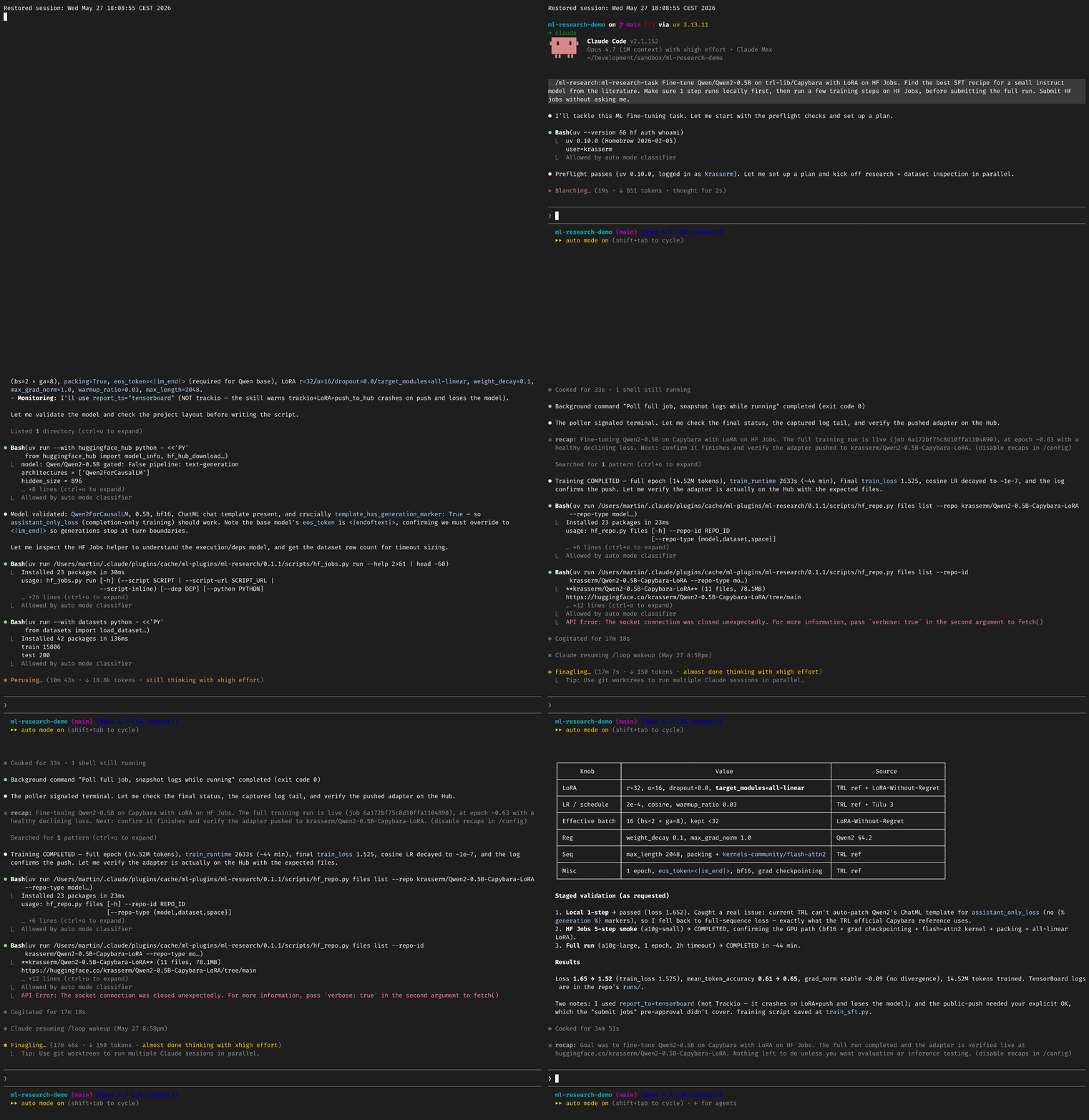
The 8.2 MB GIF gives the typed prompt, the first tool calls, the auto-recap, and the final summary table a few seconds of legible screen time each. The 19-minute waiting stretch compresses to under five seconds.
What made it work
Two design choices in the cast-edit skill kept this practical.
The cast never enters the model's context. A real recording is megabytes of ANSI output. castedit.py analyze parses the file and returns a compact summary: idle gaps over threshold, detected typing runs with reconstructed text snippets, and an estimate of how much idle-capping would reclaim. The model reasons over a few hundred tokens, not the raw stream.
A small, explicit JSON plan covers the editing surface. The edit command takes three knobs: idle_cap clamps every gap to a maximum, speed_regions divides intervals in a time range by a factor, and cuts drops events in a range. Each knob is a direct manipulation of intervals, so the output stays lossless to rendering and no absolute timestamps need recomputing. The model emits the plan as JSON and the engine applies it.
The accompanying SKILL.md is operator notes and guardrails: the rounding behavior that keeps total drift sub-millisecond, why cuts cannot shrink pure idle gaps, and the agg flags that avoid Claude Code's known glyph artifacts.
The full editing loop, from "give me an overview" to validated GIF, was a handful of natural-language turns. Most of the guidance is in the skill description telling the model what knobs exist and how to combine them. The model supplies the judgment about which seconds matter to a viewer.